Building a Production-Ready AI Chatbot Platform: Lessons from Convot
Deep-dive into the architecture decisions, ingestion pipelines, and hard-won lessons from building Convot — an embeddable AI chatbot that retrieves answers from your own knowledge base.
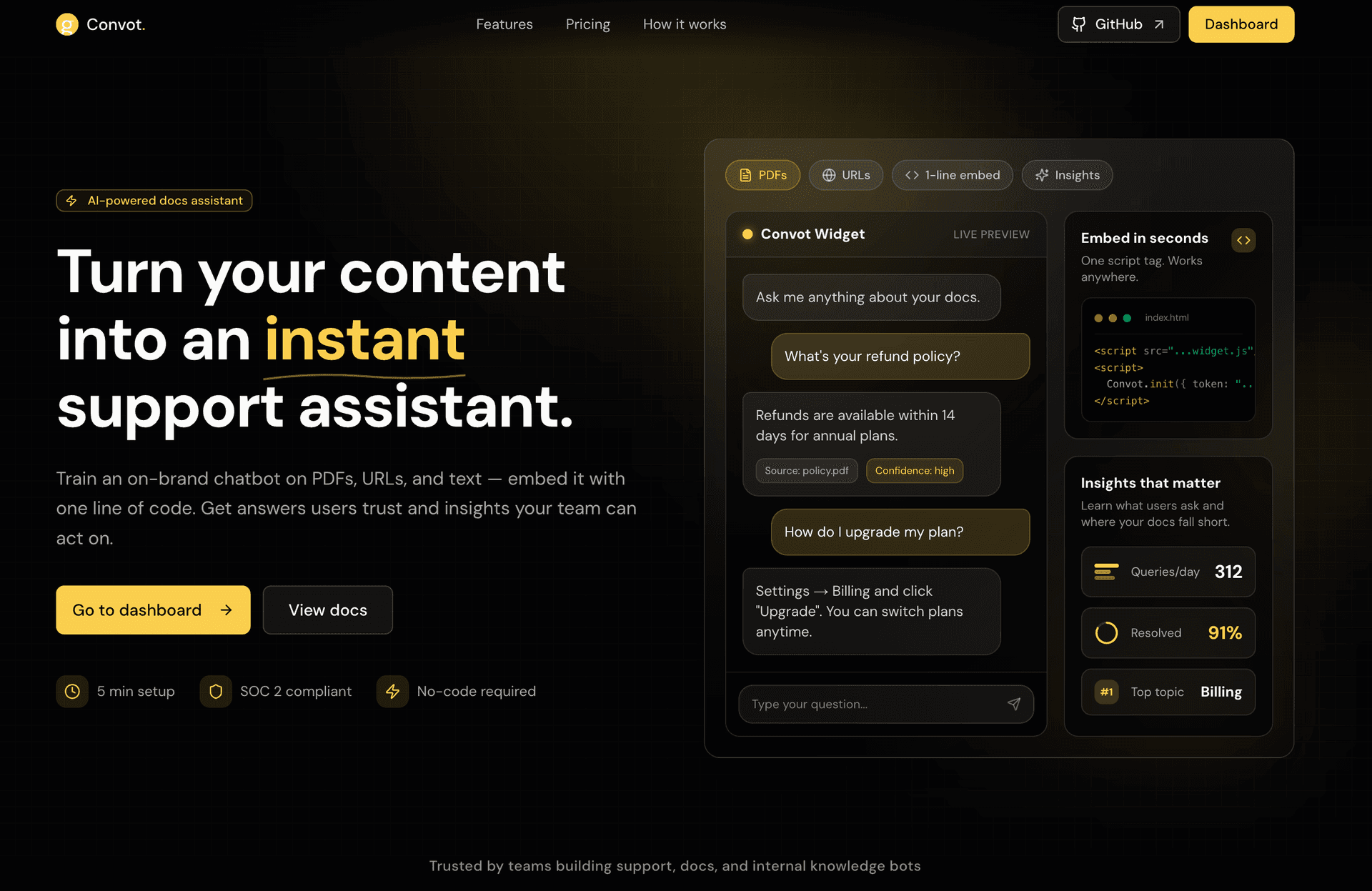
Building a production-ready AI chatbot is very different from building a demo. Over six months of building Convot, I learned that the hard part isn't the LLM — it's everything around it. This post shares the key architectural decisions and lessons that made the difference.
The Core Problem
When businesses want to give their users AI-powered answers, they face a fundamental challenge: generic LLMs don't know your specific data. Fine-tuning is expensive and slow. RAG (Retrieval-Augmented Generation) is the pragmatic middle ground — you retrieve relevant context at query time and inject it into the prompt.
But implementing RAG well is harder than it looks.
Architecture Overview
Convot's architecture has three main layers:
User Query
    │
    ▼
┌─────────────────────────────┐
│     Query Processing        │
│  - Embedding generation     │
│  - Hybrid search (dense +   │
│    sparse)                  │
└────────────┬────────────────┘
             │
    ┌────────▼────────┐
    │  Vector Store   │  ← Pinecone / pgvector
    └────────┬────────┘
             │ Top-K chunks
    ┌────────▼────────────────┐
    │   LLM Generation        │
    │  - Context injection    │
    │  - Source attribution   │
    └─────────────────────────┘
Ingestion Pipeline: The Underrated Part
Most tutorials focus on the query side. The ingestion pipeline is equally critical.
Challenge 1 — Chunking Strategy
Naive chunking (split every N tokens) breaks semantic coherence. We moved to semantic chunking: using embedding similarity to detect natural break points in the text. This dramatically improved retrieval precision.
def semantic_chunk(text: str, similarity_threshold: float = 0.8) -> list[str]:
    sentences = split_into_sentences(text)
    embeddings = embed_batch(sentences)
    chunks = []
    current_chunk = [sentences[0]]

    for i in range(1, len(sentences)):
        sim = cosine_similarity(embeddings[i-1], embeddings[i])
        if sim < similarity_threshold:
            chunks.append(" ".join(current_chunk))
            current_chunk = []
        current_chunk.append(sentences[i])

    if current_chunk:
        chunks.append(" ".join(current_chunk))
    return chunks
Challenge 2 — Multi-tenant Isolation
Every customer's knowledge base must be strictly isolated. We used namespace-based isolation in Pinecone, where each tenant gets its own namespace. At query time, the namespace is derived from the authenticated API key — zero chance of cross-tenant leakage.
Challenge 3 — Incremental Sync
Re-ingesting the entire knowledge base on every update is too slow and expensive. We implemented a content-hash based diff — only changed documents trigger re-embedding.
Structured Prompt Design
This was the single biggest lever for answer quality. Instead of a generic system prompt, we built structured prompts tailored to each knowledge base type:
SYSTEM_PROMPT = """
You are a helpful assistant for {company_name}.
Answer ONLY based on the provided context.
If the answer is not in the context, say: "I don't have that information."

Rules:
- Be concise and direct
- Always cite the source document
- Never fabricate information
- Format code blocks properly
"""
This alone reduced hallucinations by ~60% compared to a general system prompt.
The Embed Widget
The one-line embed (<script src="convot.js" data-key="..."></script>) required a careful isolation strategy — the widget injects an <iframe> with sandbox attributes to prevent style conflicts with the host page.
Key Takeaways
- Chunking strategy matters more than the model choice — invest time here first.
- Multi-tenancy is a security requirement, not a nice-to-have — design it in from day one.
- Structured prompts beat generic ones by a huge margin for domain-specific answers.
- Source attribution is a product differentiator — users trust answers that cite sources.
- Start with a small, curated knowledge base to validate retrieval quality before scaling.
Building Convot was one of the most technically challenging and rewarding projects I've worked on. Happy to answer questions in the comments or on X.